The Net Externalities of Dogs and Cats: An Analysis
The Net Externalities of Dogs and Cats
A Stockitchen Economics Publication
Abstract
In today's pet market, there are two major players families choose from when purchasing. We are talking about dogs and cats. An ageless debate, right up their with Jordan and Lebron (respect Kobe's five). In this study, I intend to analyze the qualitative economic externalities provided by in each of the dog and cat markets, and to propose policy solutions to move the market quantity and price closer to allocative efficiency, to better manage our resources. I ignore minor pets, such as fish, reptiles, etc. because there third party impacts after an economic transaction are negligible and therefore needless to analyze. So, in this paper, I will show that the dog market has a net positive externality and the the cat market a negative one, and propose how to fix these departures from allocative efficiency, decreasing market deadweight loss.
Background
To use net externality as a method of economic analysis, we must first understand what an externality is. An economic externality is a cost or benefit that a third party takes on who is outside of a two-party economic transaction. For example, a negative externality, or cost would be the pollution caused by a person driving a car. A third party has the cost of poorer air quality, but does not drive the car. A positive externality would be a benefit, as you can imagine. Externalities can be graphed using marginal social benefit and cost curves, and marginal private benefit and cost curves. Marginal private benefit/cost curves are derived from the direct benefits/costs for the person making the transaction, similar to demand and supply curves. Marginal social benefit/cost curves include costs/benefits to third parties, thus showing an externality. I believe some graphs would be helpful to visually see this effect:
Negative Externality
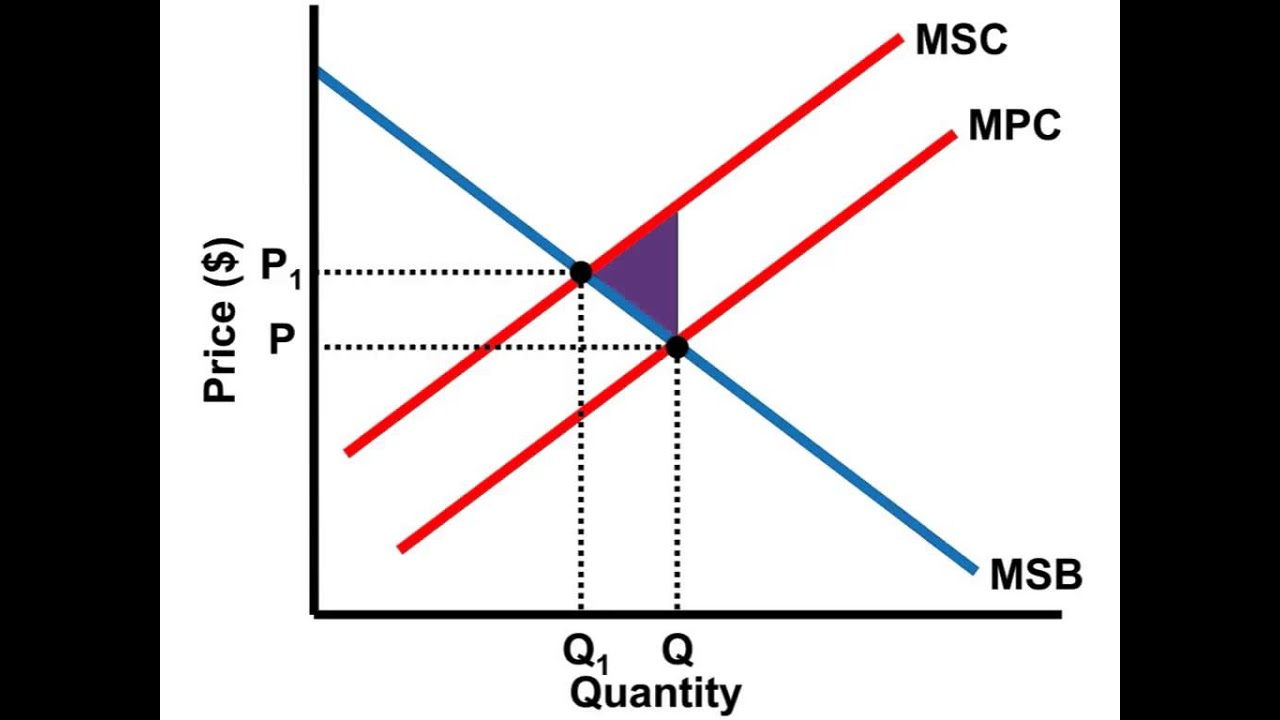
The purple triangle is deadweight loss incurred in the departure from allocative efficiency. MSC is greater than MPC because of the third party cost in a negative externality. To move to allocative efficiency, the marginal private cost of the good must be increased, or the quantity artificially restricted via quotas.
Positive Externality
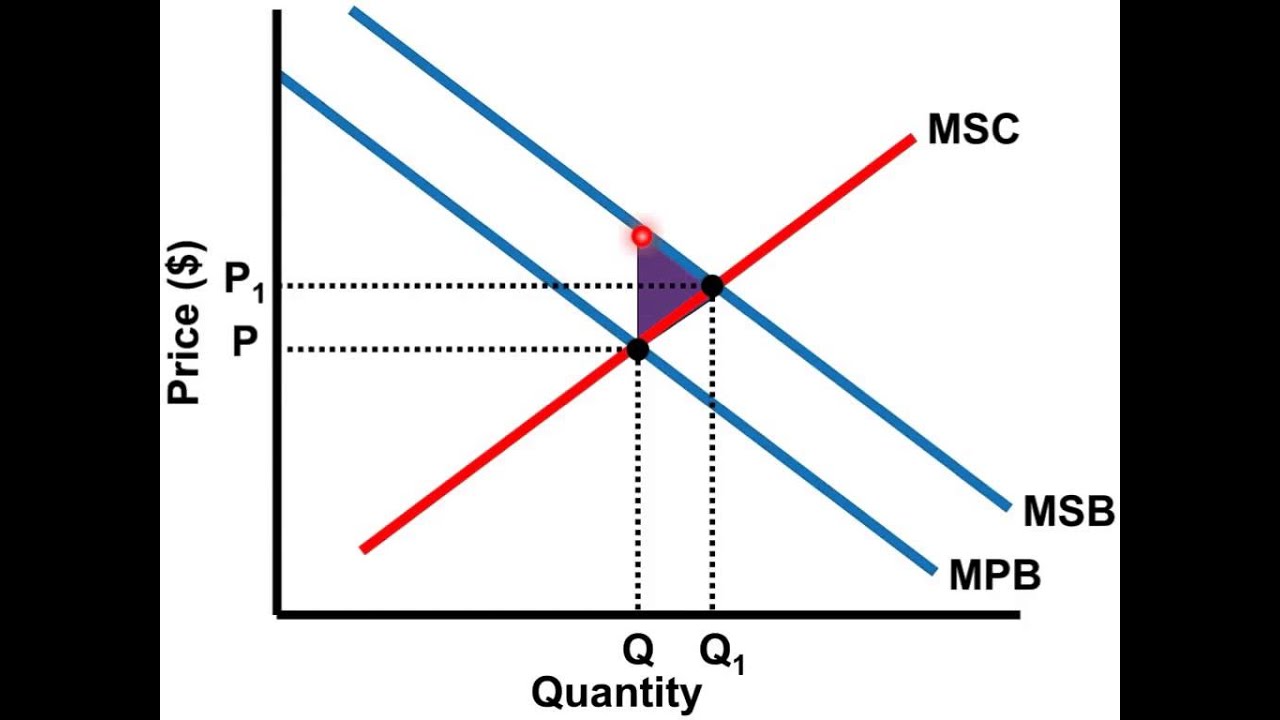
Again, the triangle is deadweight loss. MSB is greater than MPB because of the third party benefit in a positive externality. To shift to allocative efficiency, MSC must be decreased to increase the quantity bought and sold.
Analysis
Now, we will analyze the net externalities present in the dog and cat market. We will do this qualitatively, based off research and experience incorporating consumer preference (util) ideas.
Dogs
Dogs are found to a have a positive externality by this study. When a puppy is purchased, the third party benefits incurred are massive. The utils provided just from seeing a cute puppy alone are huge. Also, playing with your friends, acquaintances, and even strangers puppies creates value for a third party from fun and cuteness. Dogs have been known to be heroes in life saving scenarios, rescuing children from frozen ponds and such. This is certainly a third party benefit. Dogs can be trained in various societal benefiting roles. Seeing eye dogs, not only create value for the blind person, they create value for society since blind people will not be walking into the street. Drug dogs not only create value for the police, they create value for society by taking drugs and dangerous people off the streets. In general, dogs tend to be a reassuring and comforting presence in society. Now, you may say that I am on record as saying pitbulls are ugly and stupid dogs to own. While they may be a negative externality good, the overall net externality for the dog market in general is still quite positive.
Cats
Cats are found to have a negative externality by this study. Adult cats run the gamut of personalities, and our research has shown that over half of cats are not fun to play with, providing no externality to a third party. Approximately 30% of cats are unpleasant to third parties, a negative externality. Many cats roam freely, getting in the way of other people trying to live their lives. An anecdotal example is a cat that roams a friend's backyard terrorizing the birds he likes to observe in his backyard. Cats jump onto tables and get near food, where third party dinner guests have the cost of eating cat hair. In general, cats are not pleasant animals to have in society. Some may say that kittens are cute and add value to third parties in a similar way to puppies. I acknowledge that may be true, but adult dogs are still cute and cats are unattractive, eerie animals that put people on edge.
Solution
I propose that policy makers take a few actions to remove deadweight loss from the cat and dog market. In the dog market, I propose a buyer subsidy. This would decrease the marginal social cost of purchasing a dog, increasing the quantity exchanged to the allocative efficient quantity. That is a good start. However, the positive externality may be so large that the government would be better off providing dogs as a public good. There are many federal and state budget items I would cut to add dogs in. Slash teacher pay if you need to. In the cat market, I propose a quota on how many cats can be purchased in a year. The number would be drastically lower than the current market quantity to account for the large negative externality. I call on policy makers to make these changes to return these markets to allocative efficiency and maximize the benefits to society.
© Stockitchen 2018


Comments
Post a Comment